Journal
Why Two Patients Can Undergo the Same Plastic Surgery… Yet Experience Completely Different Results
Understanding the Biology Behind Healing, Recovery, and Long-Term Surgical Outcomes
 Dr. Raman Mehrzad, MDPlastic surgeon
Published July 13, 2026Updated August 18, 20266 min read
Medically reviewed by Dr. Raman Mehrzad, MD. Last reviewed August 18, 2026.
Now: Understanding the Biology Behind Healing, Recovery, and Long-Term Surgical Outcomes
Understanding the Biology Behind Healing, Recovery, and Long-Term Surgical Outcomes
By Dr. Raman Mehrzad, MD, MBA, MHL
Plastic & Reconstructive Surgeon | Ocean Plastic Surgery Center
Introduction: The Question Every Patient Should Ask
Imagine two patients arriving at the hospital on the same morning.
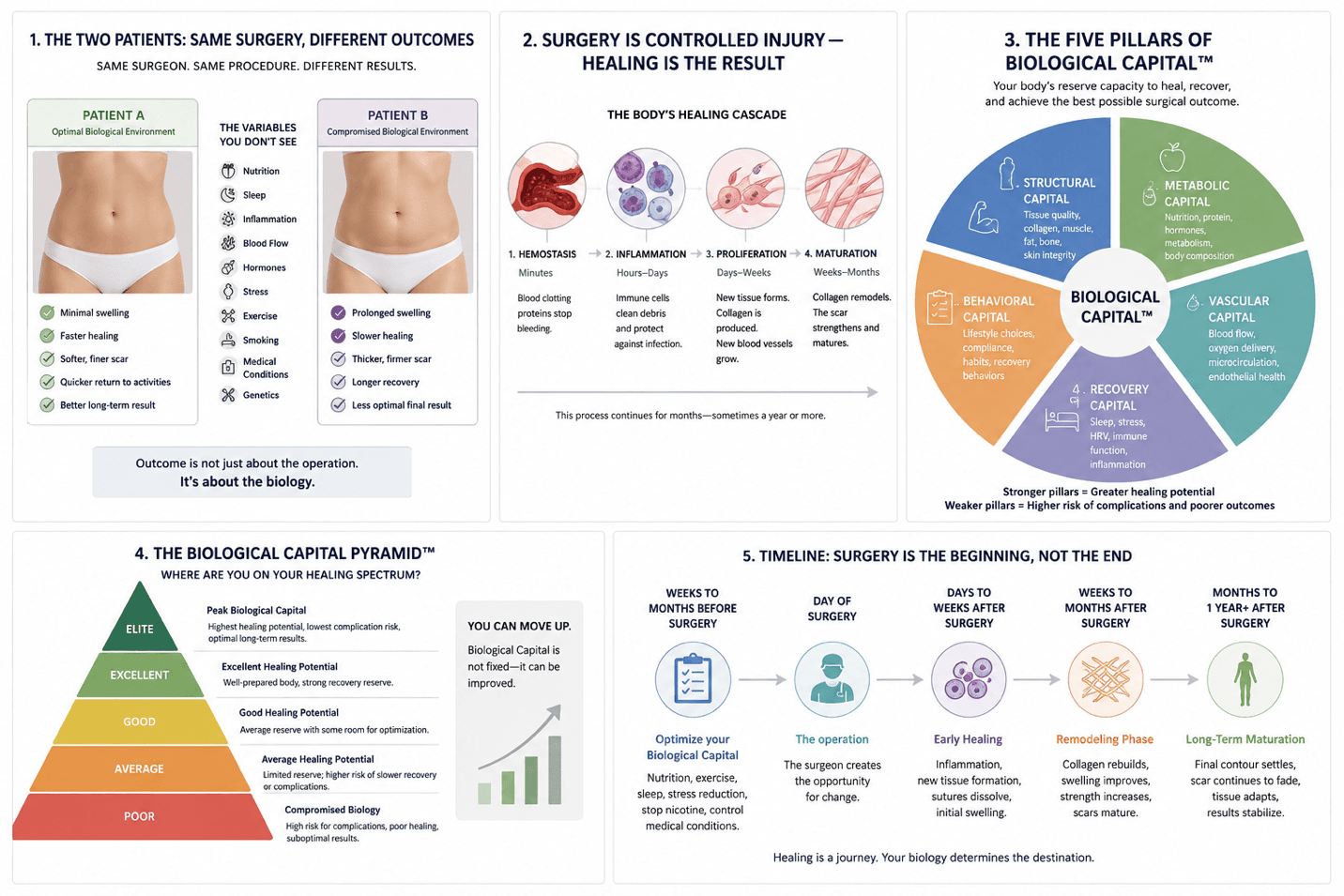
Both are healthy enough to undergo elective plastic surgery. Both are having the exact same procedure. They are similar in age, have nearly identical body types, and are cared for by the same surgeon, anesthesiologist, nurses, and operating room staff. The operation follows the same surgical plan, takes approximately the same amount of time, and is performed using the same instruments and techniques.
Six months later, however, their outcomes are strikingly different.
One patient experiences minimal swelling, heals quickly, develops an inconspicuous scar, and returns to normal activities ahead of schedule. Her tissues soften beautifully, her contour appears natural, and the final result closely matches the goals discussed before surgery.
The second patient has a much more difficult recovery. Swelling persists for months. Scar tissue becomes firmer than expected. Healing progresses more slowly, and the final result, while still improved, never quite reaches the same level.
What explains this difference?
Most people immediately assume the answer lies in the operation itself. They imagine that the outcome must be determined almost entirely by surgical technique.
Surgical technique is unquestionably one of the most important determinants of a successful outcome. A skilled plastic surgeon’s knowledge of anatomy, judgment, precision, and experience cannot be overstated.
But surgery is only one half of the equation.
The other half is something patients rarely think about until after their operation:
Biology.
The surgeon performs the operation.
The patient’s body performs the healing.
Neither can achieve an exceptional result without the other.
That simple idea forms the foundation of modern plastic surgery and serves as the central theme of this article.
Plastic Surgery Is More Than an Operation
Most people think of surgery as a single event.
They picture the consultation, the day of the operation, the recovery room, and eventually the final before-and-after photographs.
From a biological perspective, however, surgery is not a single event at all.
It is a carefully orchestrated physiological process that begins weeks before the first incision and continues for months—sometimes more than a year—after the last suture is placed.
Long before entering the operating room, every patient already possesses a unique biological environment. That environment has been shaped over decades by genetics, nutrition, physical activity, sleep, medical conditions, medications, hormonal balance, stress, smoking history, alcohol consumption, metabolic health, and countless other factors.
These variables influence how tissues receive oxygen, how efficiently collagen is produced, how the immune system responds to injury, how inflammation is regulated, and ultimately how the body repairs itself.
Plastic surgery does not erase these biological differences.
It reveals them.
The operation creates the opportunity for change.
Healing determines how completely that opportunity is realized.
The Hidden Variable: Your Biological Capital
Throughout this educational series, I want to introduce a concept that I believe helps explain why recovery differs so dramatically from one patient to another.
I call this Biological Capital.
Think of Biological Capital as the body’s reserve capacity for healing.
Just as financial capital represents resources available to invest, Biological Capital represents the physiological resources available to recover from injury, build new tissue, resist complications, and restore normal function.
Every person accumulates—or depletes—Biological Capital throughout life.
Regular exercise contributes to it.
Nutritious eating contributes to it.
High-quality sleep contributes to it.
Well-controlled diabetes helps preserve it.
Avoiding nicotine protects it.
Chronic sleep deprivation, poor nutrition, uncontrolled medical conditions, persistent inflammation, smoking, excessive alcohol use, and prolonged psychological stress gradually reduce it.
Importantly, Biological Capital is not a fixed trait. It is dynamic. It can often be strengthened through intentional preparation before elective surgery.
This distinction is one of the reasons elective plastic surgery is unique. Unlike emergency operations, aesthetic procedures usually provide an opportunity to optimize the patient’s biological readiness before surgery takes place.
The weeks before surgery are not simply a waiting period.
They are an opportunity.
Surgery Does Not Create Healing
One of the greatest misconceptions in medicine is that surgeons heal patients.
Surgeons do not heal.
The body heals.
Surgeons create the conditions under which healing can occur.
A fracture is stabilized so bone can repair itself.
A tendon is reattached so cells can rebuild it.
A facelift repositions tissue, but the body must establish new microscopic connections, remodel collagen, restore blood supply, and reorganize scar tissue over the months that follow.
Plastic surgery depends on one of the most remarkable capabilities of the human body: its ability to regenerate, remodel, and adapt.
Every incision initiates an extraordinarily complex biological response involving millions of cells communicating through thousands of chemical signals.
Within minutes, blood clotting proteins prevent excessive bleeding.
Inflammatory cells migrate into the surgical site, not simply to create swelling but to remove damaged tissue and coordinate the earliest stages of repair.
Fibroblasts begin producing collagen, the structural protein that provides strength to healing wounds.
New blood vessels develop through angiogenesis, restoring oxygen and nutrients to recovering tissues.
Over the following months, collagen fibers are continuously reorganized, scars gradually mature, swelling resolves, and tissues regain strength.
Far from being a passive process, healing is one of the most sophisticated regenerative programs in human biology.
Plastic surgeons work with this program every day.
The better we understand it, the better we can help patients achieve exceptional outcomes.
The Philosophy of Modern Plastic Surgery
For decades, discussions about plastic surgery have focused primarily on procedures.
What is a tummy tuck?
What is liposuction?
What is a facelift?
Those are important questions.
But they are not the questions that ultimately determine how well a patient heals.
As our understanding of physiology, wound healing, nutrition, and regenerative medicine continues to evolve, plastic surgery is increasingly becoming the intersection of anatomy and biology.
Excellent results require technical excellence.
They also require respect for the biological systems that transform an operation into a long-term outcome.
At Ocean Plastic Surgery Center, I believe patients deserve to understand both.
Because the most beautiful results are not created in a single afternoon.
They are created through months of highly coordinated biological work performed by the human body itself.
The operation may last several hours.
Healing continues long after the operating room lights are turned off.
Looking Ahead
In the next section, we will explore the five pillars of Biological Capital and examine the scientific evidence behind each one. We’ll discuss how circulation, nutrition, protein intake, inflammation, metabolic health, sleep, exercise, nicotine exposure, hormones, and stress influence healing—not through myths or trends, but through established physiology and clinical evidence.
Understanding these principles can help patients become active participants in their recovery rather than passive observers of it.
Serving patients from Los Alamitos, Long Beach, Seal Beach, Orange County, Cypress, Cerritos, Lakewood, Huntington Beach, Newport Beach, and the greater Los Angeles area.