Journal
Why Does Swelling Last So Long After Plastic Surgery?
The Complete Scientific Guide to Postoperative Swelling, Fluid Retention, and Recovery
 Dr. Raman Mehrzad, MDPlastic surgeon
Published July 13, 2026Updated August 18, 20266 min read
Medically reviewed by Dr. Raman Mehrzad, MD. Last reviewed August 18, 2026.
Now: The Complete Scientific Guide to Postoperative Swelling, Fluid Retention, and Recovery
The Complete Scientific Guide to Postoperative Swelling, Fluid Retention, and Recovery
Sub Title: Why Does Swelling Last So Long After Plastic Surgery? The Complete Guide
Description: Learn why swelling occurs after plastic surgery, how long it lasts, what happens inside your body, and the science-backed ways to reduce postoperative swelling safely.
Raman Mehrzad, MD, MHL, MBA
Plastic and Reconstructive Surgeon
Ocean Plastic Surgery Center
In One Minute
Swelling is one of the most misunderstood aspects of plastic surgery. Many patients assume that swelling is a complication or that it means something has gone wrong. In reality, swelling is one of the body’s most important healing responses. It delivers immune cells, oxygen, proteins, and growth factors to injured tissues while beginning the repair process. Although excessive swelling can occasionally signal a problem, most postoperative swelling is normal, expected, and temporary. Understanding why swelling occurs—and why it often lasts much longer than patients expect—can make recovery less stressful and improve postoperative expectations.
The Question Almost Every Plastic Surgery Patient Asks
Perhaps no question is asked more frequently after cosmetic surgery than:
"Doctor… why am I still swollen?"
The question is understandable.
The incision looks healed.
The bruising has faded.
The pain has improved.
Yet the area still feels firm, puffy, tight, or larger than expected.
Many patients begin worrying that the surgery "didn’t work."
Others believe they permanently gained weight.
Some become convinced that scar tissue has already formed.
In reality, most of what they are experiencing is simply biology.
Plastic surgery changes anatomy in a matter of hours.
The body then spends months adapting to those changes.
Swelling is one of the first—and longest-lasting—parts of that adaptation.
Swelling Is Not the Enemy
One of the biggest misconceptions in recovery is that swelling should be eliminated as quickly as possible.
That is not how healing works.
Swelling is not a mistake made by the body.
It is a deliberate biological strategy.
Immediately after surgery, tiny blood vessels become more permeable. This allows fluid, proteins, immune cells, and healing molecules to leave the bloodstream and enter the surrounding tissues.
Why?
Because healing cannot occur if the body’s repair system remains trapped inside blood vessels.
The temporary movement of fluid into tissues creates the familiar fullness known as postoperative swelling.
Without this process, wounds would not heal efficiently.
The Mehrzad Clinical Insight
Patients often ask me how to "get rid of swelling."
I explain that the goal is not to eliminate swelling.
The goal is to allow the body to complete the healing process that swelling represents.
Healthy recovery is about supporting biology—not fighting it.
What Actually Causes Swelling?
Swelling develops through several biological mechanisms occurring simultaneously.
1. Increased Blood Flow
Immediately after surgery, blood vessels widen to deliver oxygen and nutrients to healing tissue.
This increased circulation supports repair but also contributes to fluid accumulation.
2. Increased Vascular Permeability
Inflammatory signaling molecules temporarily create microscopic openings between cells lining blood vessels.
These openings allow healing proteins and immune cells to enter injured tissue.
Fluid naturally follows.
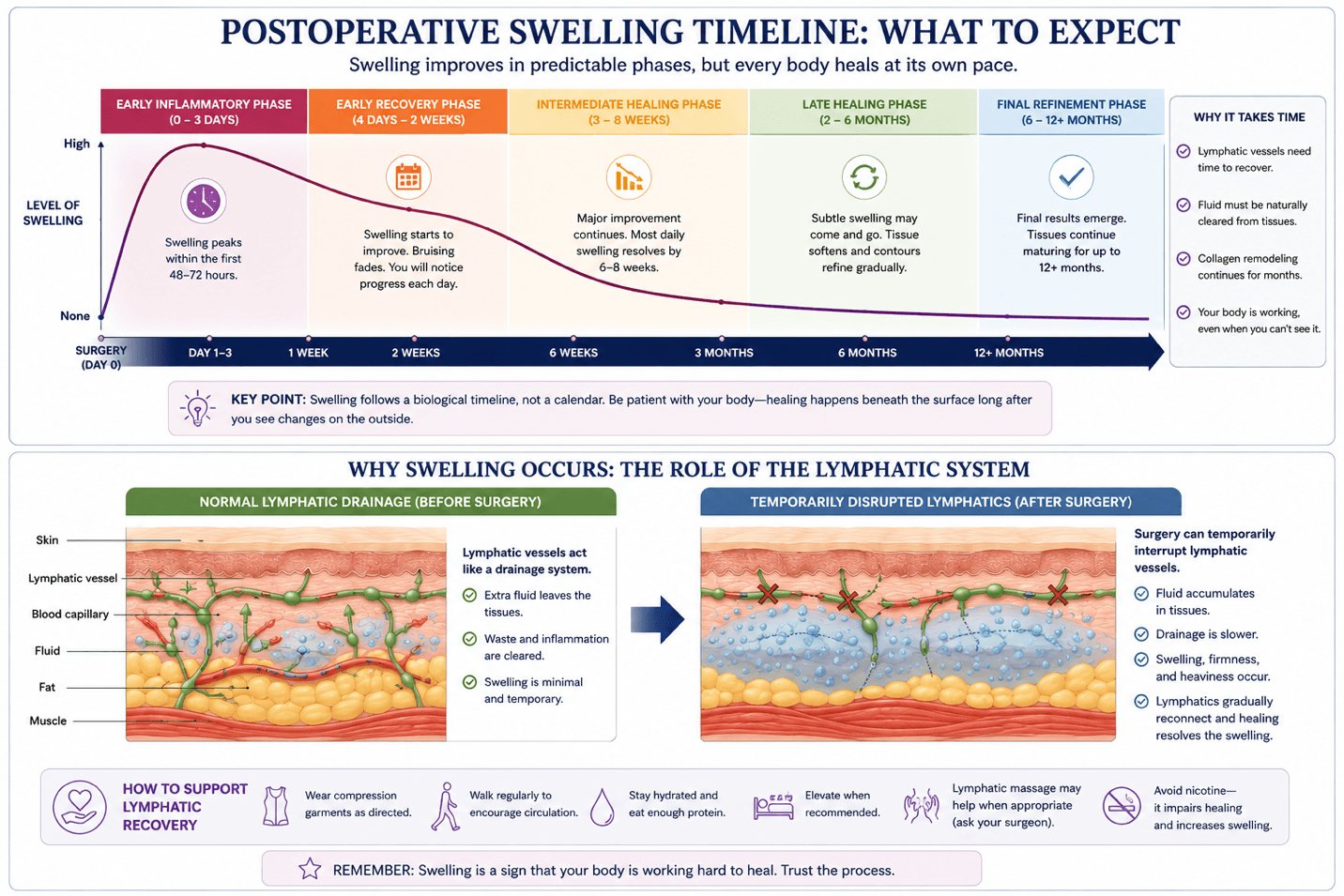
3. Lymphatic Disruption
The lymphatic system acts as the body’s drainage network.
During many procedures—including tummy tucks, liposuction, facelifts, neck lifts, and body contouring—small lymphatic vessels are temporarily disrupted.
Until these channels regenerate and reconnect, fluid clearance is less efficient.
This is one of the primary reasons swelling can persist for weeks or even months after otherwise successful surgery.
4. Gravity
Swelling follows gravity.
After facial surgery, swelling often appears worse around the jawline and neck.
After abdominal surgery, fluid frequently settles into the lower abdomen, pubic region, or upper thighs.
Patients are often surprised by these changes, but they are entirely predictable.
Why Does Swelling Feel Hard?
Many patients expect swelling to feel soft.
Instead, they often notice areas that feel surprisingly firm.
This firmness usually reflects a combination of tissue edema, early collagen deposition, and temporary inflammatory remodeling—not permanent scar tissue.
As healing progresses, these tissues gradually soften.
That process cannot be rushed.
It follows biology’s timeline rather than the calendar.
How Long Does Swelling Last?
This is one of the most important questions patients ask.
The honest answer is that it depends on the procedure, the patient, and the body’s biology.
In general:
- The greatest swelling occurs during the first several days.
- Significant improvement usually occurs over the first 4–8 weeks.
- Subtle swelling may persist for several months.
- Final refinement after many procedures continues for 6–12 months, and occasionally longer.
This explains why experienced plastic surgeons often tell patients that their final result cannot be judged only a few weeks after surgery.
Healing is still occurring beneath the surface long after the skin appears normal.
Why Some Patients Swell More Than Others
No two patients heal identically.
Several factors influence postoperative swelling, including:
- The extent of surgery
- Individual inflammatory responses
- Tissue quality
- Lymphatic recovery
- Body composition
- Nutrition
- Protein intake
- Smoking or nicotine exposure
- Diabetes and metabolic health
- Physical activity during recovery
- Genetics
This is one reason why comparing your recovery with someone else’s on social media is rarely helpful.
Two people may undergo the same procedure and follow the same instructions while still experiencing different healing timelines.
Can You Reduce Swelling?
Although swelling cannot be eliminated completely, patients can often support the body’s natural recovery by:
- Following compression garment recommendations.
- Walking regularly to encourage circulation.
- Maintaining adequate hydration.
- Consuming sufficient dietary protein.
- Limiting excessive sodium intake when appropriate.
- Avoiding nicotine products.
- Sleeping according to postoperative recommendations.
- Attending scheduled follow-up appointments.
- Following individualized advice regarding lymphatic massage when indicated.
Recovery is not about forcing swelling to disappear.
It is about creating the best possible biological environment for healing.
When Swelling Is Not Normal
Most swelling is expected.
However, patients should contact their surgeon promptly if swelling is:
- Rapidly increasing on one side.
- Associated with severe pain that is worsening rather than improving.
- Accompanied by significant redness, warmth, fever, or drainage.
- Associated with shortness of breath, chest pain, or other concerning symptoms.
While uncommon, these findings may indicate complications that require prompt medical evaluation.
Key Takeaways
- Swelling is a normal and essential part of healing.
- The lymphatic system plays a major role in how quickly swelling resolves.
- Firmness often reflects normal healing rather than permanent scar tissue.
- Final results should be judged months—not weeks—after surgery.
- Every patient’s biological timeline is unique.
Related Reading
To better understand why swelling occurs and how the body repairs itself, continue with:
- The Complete Science of Wound Healing
- Why Two Patients Can Have the Same Plastic Surgery… But Completely Different Results
- The Biology of Scar Formation (coming soon)
- Protein and Plastic Surgery Recovery (coming soon)
- The Science of Compression Garments (coming soon)
Serving patients from Los Alamitos, Long Beach, Seal Beach, Orange County, Cypress, Cerritos, Lakewood, Huntington Beach, Newport Beach, and the greater Los Angeles area.