Journal
Why Do Scars Form? The Complete Science of Scar Formation, Healing, and Scar Optimization
Every surgical incision heals with a scar. Contrary to popular belief, scars are not signs that the body failed to heal—they are evidence that it successfully repaired injured tissue. The quality of a scar depends on numerous biological factors, including genetics, collagen production, inflammation,
 Dr. Raman Mehrzad, MDPlastic surgeon
Published July 13, 2026Updated August 18, 20266 min read
Medically reviewed by Dr. Raman Mehrzad, MD. Last reviewed August 18, 2026.
Now: One of the Biggest Misconceptions in Plastic Surgery
Sub Title: Why Do Scars Form? The Complete Guide to Scar Healing After Plastic Surgery
Description: Discover why scars form, how they mature, why some scars become thick or raised, and the science-backed ways to optimize scar healing after plastic surgery.
Raman Mehrzad, MD, MHL, MBA
Plastic and Reconstructive Surgeon
Ocean Plastic Surgery Center
In One Minute
Every surgical incision heals with a scar. Contrary to popular belief, scars are not signs that the body failed to heal—they are evidence that it successfully repaired injured tissue. The quality of a scar depends on numerous biological factors, including genetics, collagen production, inflammation, wound tension, blood supply, nutrition, surgical technique, postoperative care, and time. Understanding how scars form helps patients set realistic expectations and maximize the chance of achieving the best possible cosmetic outcome.
One of the Biggest Misconceptions in Plastic Surgery
One of the first questions patients ask during a consultation is:
"Will I have a scar?"
The honest answer is simple.
Yes.
Every incision leaves a scar.
The better question is:
"What kind of scar will my body create?"
That is where the science becomes fascinating.
Plastic surgery is not about eliminating scars.
It is about placing them thoughtfully, minimizing their visibility, and creating the biological conditions that allow them to mature as favorably as possible.
Even the most meticulous incision cannot heal invisibly if biology is working against it.
Likewise, excellent biology cannot fully compensate for poor surgical planning.
The best scars result from a partnership between surgical technique and wound healing biology.
What Is a Scar?
A scar is the body’s natural solution to a difficult problem.
When skin is injured deeply enough that its normal architecture cannot simply regenerate, the body rapidly replaces the damaged tissue with collagen-rich connective tissue.
This replacement tissue restores strength far more quickly than perfect regeneration would.
From an evolutionary perspective, survival has always been more important than appearance.
The body prioritizes closing the wound, preventing infection, and restoring structural integrity.
Cosmetic perfection comes later.
Your Body Builds a Temporary Bridge
Imagine that a major bridge crossing a river suddenly collapses.
Would engineers spend years designing the perfect replacement before reopening traffic?
Of course not.
They would first build a temporary bridge to restore function.
Only afterward would they refine and strengthen the permanent structure.
Scar formation follows a similar strategy.
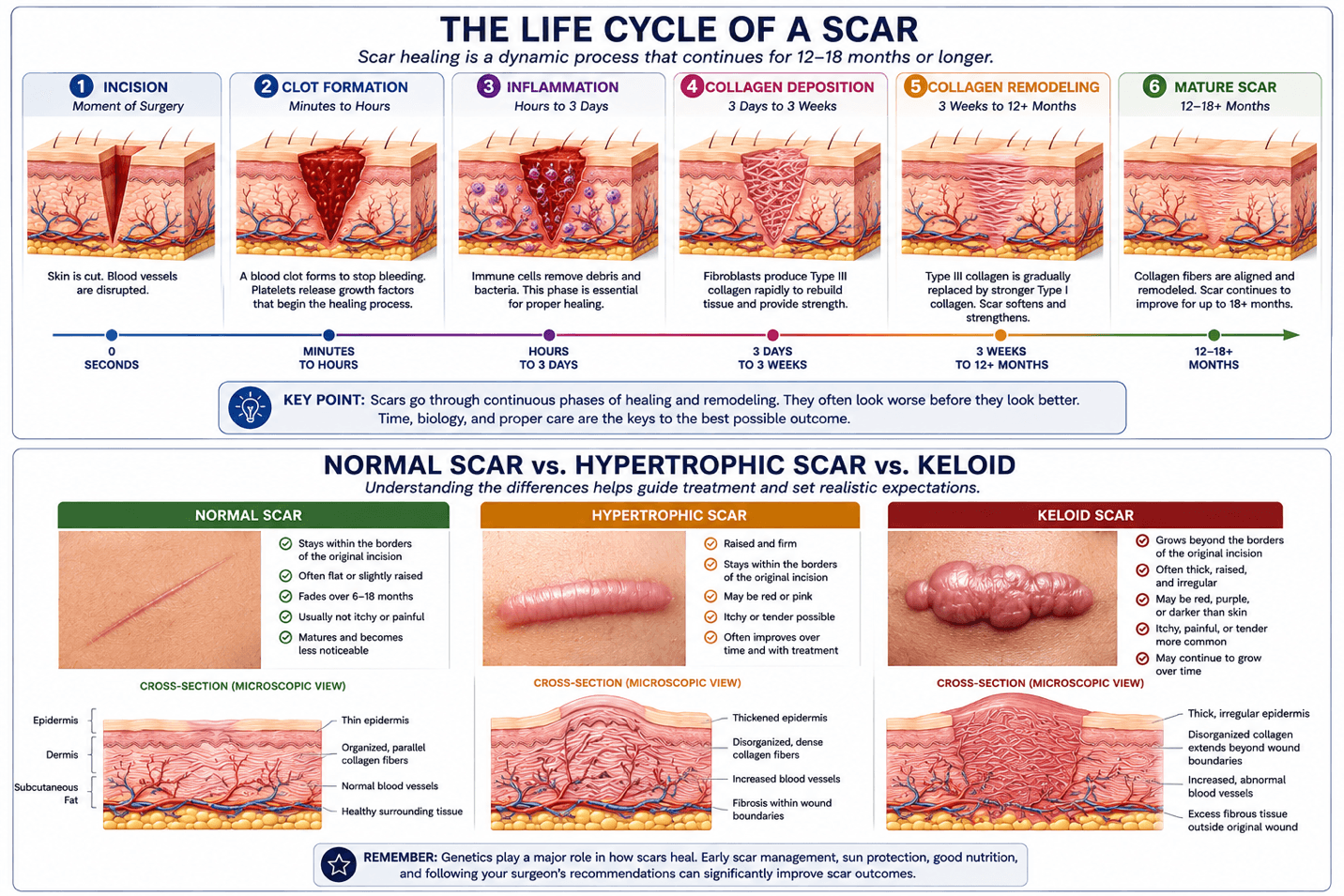
The first collagen produced after surgery is primarily Type III collagen.
It is laid down rapidly to stabilize the wound.
Over the following months, much of this temporary collagen is replaced, reorganized, and strengthened into predominantly Type I collagen, creating a scar that is stronger, flatter, and more organized.
This remodeling process explains why scars often continue improving for twelve to eighteen months after surgery.
The Mehrzad Clinical Insight
Many patients judge their scar far too early.
A scar that appears red, firm, or raised at six weeks may look dramatically different one year later.
Healing has its own biological timeline.
Patience is not simply emotional—it is physiological.
Why Are New Scars Red?
Patients are often surprised that fresh scars appear bright pink or even red.
This is completely normal.
During healing, the body creates thousands of microscopic new blood vessels through a process called angiogenesis.
These vessels deliver oxygen, nutrients, immune cells, and growth factors needed for repair.
Because the scar contains more blood vessels than surrounding mature skin, it appears red.
As healing progresses and the demand for increased blood flow decreases, many of these vessels naturally regress.
The scar gradually becomes lighter and blends more closely with the surrounding skin.
This process takes months—not weeks.
Why Do Some Scars Become Thick?
Not every scar follows the same biological pathway.
Some scars remain thin and barely visible.
Others become raised, firm, itchy, or wider than expected.
Several factors influence this outcome.
Genetics
Perhaps the strongest predictor of scar behavior is genetics.
Some individuals naturally produce more collagen during healing than others.
Wound Tension
Scars located over areas of constant movement or high mechanical tension often widen over time.
This is one reason plastic surgeons carefully plan incision placement along relaxed skin tension lines whenever possible.
Prolonged Inflammation
Excessive or prolonged inflammation may stimulate increased collagen deposition and contribute to thicker scars.
Infection
Even mild wound infections can disrupt normal healing and negatively influence scar quality.
Smoking and Nicotine
Reduced blood flow impairs organized healing and increases the risk of less favorable scar maturation.
Nutrition
Protein, vitamin C, zinc, copper, and adequate caloric intake all contribute to healthy collagen synthesis.
Hypertrophic Scars Versus Keloids
Patients frequently use these terms interchangeably, but they are not the same.
A hypertrophic scar remains confined to the boundaries of the original incision.
It is raised because the body temporarily produces more collagen than necessary during healing.
Many hypertrophic scars gradually improve with time and appropriate treatment.
A keloid, on the other hand, extends beyond the borders of the original wound.
Keloids represent an abnormal healing response and may continue enlarging over time.
Although both involve increased collagen production, they behave differently and often require different treatment strategies.
Understanding this distinction is important because prognosis and management differ significantly.
Scar Strength Is Not Immediate
One of the greatest misconceptions is that a closed incision has regained its original strength.
It has not.
Even after stitches are removed, the wound remains biologically immature.
At approximately two weeks, the incision possesses only a fraction of its ultimate tensile strength.
Over the following months, collagen fibers become thicker, stronger, and better organized.
Even after one year, healed skin usually reaches about 70–80% of the tensile strength of uninjured skin.
This is one reason surgeons provide postoperative activity restrictions.
Those restrictions are designed not simply to protect stitches, but to protect collagen while it is still developing.
The Mehrzad Clinical Insight
Patients often ask when they are "fully healed."
The skin may appear healed long before the collagen beneath it has finished maturing.
What you see on the surface is only part of the healing story.
Can Patients Improve Their Scar?
Although genetics cannot be changed, many aspects of scar healing can be optimized.
Evidence supports several strategies that may improve scar maturation when appropriate for the individual patient:
- Following all postoperative wound care instructions.
- Avoiding nicotine exposure.
- Maintaining adequate protein intake.
- Protecting healing scars from ultraviolet light.
- Using silicone-based scar therapy when recommended.
- Avoiding unnecessary tension on healing incisions.
- Attending scheduled follow-up appointments so concerns can be identified early.
Scar optimization is rarely about one miracle treatment.
It is about consistently supporting healthy biology throughout the months-long remodeling process.
The Future of Scar Science
Scar biology remains one of the most active areas of research in regenerative medicine.
Scientists are investigating methods to reduce fibrosis, modulate inflammatory signaling, influence fibroblast behavior, improve collagen organization, and encourage tissue regeneration rather than scar formation.
Although perfect scar-free healing remains an important scientific goal, current evidence continues to emphasize meticulous surgical technique, healthy wound biology, and thoughtful postoperative care as the most reliable path toward excellent outcomes.
Key Takeaways
- Every surgical incision heals with a scar.
- A scar represents successful tissue repair—not failed healing.
- Scar quality depends on both surgical technique and patient biology.
- Scar maturation continues for 12–18 months in many patients.
- Genetics matter, but nutrition, wound care, nicotine avoidance, sun protection, and tension management also influence the final result.
Related Reading
Continue learning with:
- The Complete Science of Wound Healing
- Why Does Swelling Last So Long After Plastic Surgery?
- Why Two Patients Can Have the Same Plastic Surgery…But Completely Different Results
- The Biology of Collagen (Coming Soon)
- Silicone Scar Therapy: Does It Really Work? (Coming Soon)
Serving patients from Los Alamitos, Long Beach, Seal Beach, Orange County, Cypress, Cerritos, Lakewood, Huntington Beach, Newport Beach, and the greater Los Angeles area.