Journal
Why You Must Stop Smoking and Vaping Before Plastic Surgery
The Complete Scientific Guide to Nicotine, Blood Flow, Wound Healing, and Surgical Outcomes
 Dr. Raman Mehrzad, MDPlastic surgeon
Published July 13, 2026Updated August 18, 20265 min read
Medically reviewed by Dr. Raman Mehrzad, MD. Last reviewed August 18, 2026.
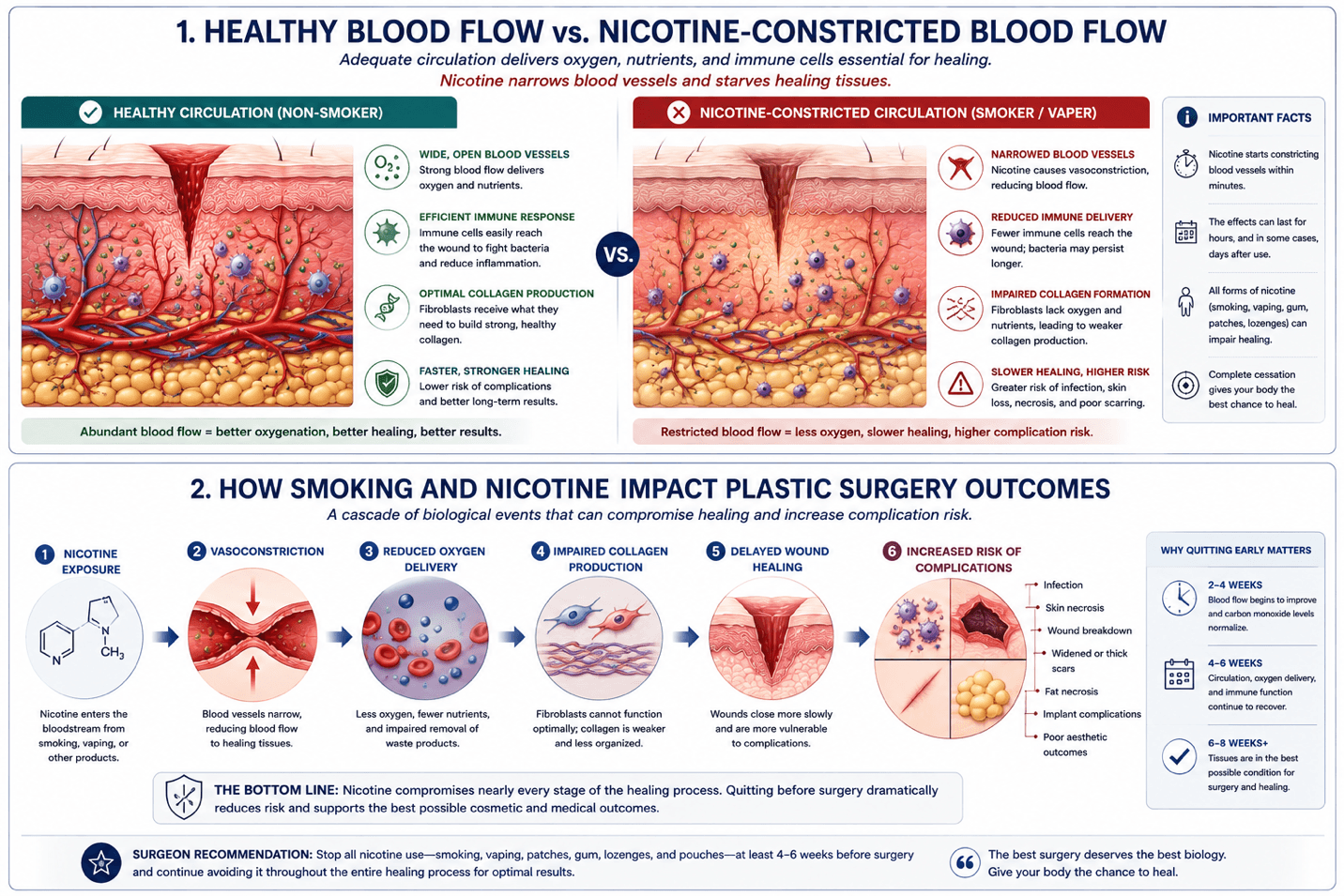
Now: Plastic Surgery Depends on Blood Supply
The Complete Scientific Guide to Nicotine, Blood Flow, Wound Healing, and Surgical Outcomes
If there is one lifestyle habit that consistently increases the risk of wound healing complications after plastic surgery, it is nicotine exposure. Whether it comes from cigarettes, cigars, vaping devices, nicotine pouches, patches, or gum, nicotine causes blood vessels to narrow, reducing the delivery of oxygen and nutrients to healing tissues. Plastic surgery depends on healthy circulation. Without adequate blood flow, the risks of delayed healing, infection, skin loss, fat necrosis, widened scars, implant complications, and poor cosmetic outcomes increase substantially. Understanding why nicotine affects healing can help patients make informed decisions and maximize their surgical results.
One Small Molecule. One Massive Impact.
Every year, millions of patients undergo elective cosmetic surgery.
Many spend months researching surgeons.
They compare before-and-after photographs.
They study reviews.
They choose procedures carefully.
Yet one of the most important determinants of healing often receives far less attention.
Nicotine.
Whether inhaled, chewed, absorbed through the skin, or delivered by vapor, nicotine profoundly affects the biology that plastic surgeons rely on every day.
Plastic surgery is unique among medical specialties because success depends not only on what happens in the operating room but also on what happens within the microscopic blood vessels supplying the tissues after surgery.
Healthy blood flow is not simply beneficial.
It is essential.
Plastic Surgery Depends on Blood Supply
Every incision interrupts thousands of microscopic blood vessels.
Fortunately, the body immediately begins rebuilding these vascular connections.
New capillaries grow.
Existing vessels expand.
Oxygen delivery increases.
Immune cells migrate.
Collagen production accelerates.
Healing progresses.
This remarkable sequence depends on one critical factor:
Blood must be able to reach the tissues.
Anything that interferes with circulation directly interferes with healing.
That is why plastic surgeons pay such close attention to blood supply when planning incisions, elevating tissue flaps, performing facelifts, tummy tucks, breast reductions, body lifts, and reconstructive procedures.
The surgery may create beautiful anatomy.
The blood supply keeps it alive.
What Nicotine Does Inside Your Body
Many people believe nicotine simply raises heart rate or increases blood pressure.
Its effects are far more complex.
Within minutes of entering the bloodstream, nicotine stimulates the release of catecholamines such as adrenaline.
These hormones cause blood vessels to constrict.
The diameter of small arteries decreases.
Blood flow slows.
Less oxygen reaches healing tissues.
Less nutrition reaches healing tissues.
Waste products are removed more slowly.
The tissues most vulnerable after surgery, the very tissues attempting to survive while new blood vessels develop, are suddenly receiving less of everything they need.
This is why nicotine is particularly concerning in plastic surgery.
Unlike many other operations, plastic surgery frequently involves repositioning skin and soft tissue while relying on delicate microcirculation to maintain tissue viability.
The Mehrzad Clinical Insight
Plastic surgeons are not asking patients to stop nicotine because of a rule.
We ask because plastic surgery is fundamentally dependent on blood flow.
Healthy circulation is the difference between tissue that thrives and tissue that struggles to heal.
Smoking Is More Than Nicotine
Although nicotine alone impairs circulation, traditional cigarettes create additional challenges.
Cigarette smoke contains carbon monoxide.
Carbon monoxide binds to hemoglobin approximately 200 times more strongly than oxygen.
As a result, blood carries less oxygen to healing tissues.
Imagine trying to rebuild a house while every delivery truck arrives half empty.
Healing becomes slower, less efficient, and more vulnerable to complications.
Smoking also introduces thousands of additional chemicals that increase oxidative stress, damage the lining of blood vessels, and contribute to chronic inflammation.
The combined effect is far greater than nicotine alone.
“But I Vape Instead.”
One of the most common questions patients ask is whether vaping is safer before surgery.
From a wound-healing perspective, the answer is often misunderstood.
Although vaping eliminates many combustion products found in cigarettes, most vaping products still deliver nicotine.
The blood vessels do not distinguish whether nicotine arrived through cigarette smoke or vapor.
They respond in the same way.
For plastic surgery, the biological concern is not how nicotine entered the bloodstream.
It is that it entered the bloodstream at all.
Why Plastic Surgeons Worry About Skin Loss
Few complications are more devastating than tissue necrosis.
Fortunately, it is uncommon.
However, when blood flow becomes severely compromised, portions of skin or fat may not receive enough oxygen to survive.
Patients are often surprised that tissue survival depends on microscopic blood vessels invisible to the naked eye.
Yet those tiny vessels determine whether tissues heal normally.
This is one reason procedures involving large skin flaps, such as facelifts, tummy tucks, breast reductions, body lifts, and reconstructive surgery, require particularly careful attention to circulation.
The Bottom Line
Plastic surgery is an investment in your appearance, your confidence, and your health.
The weeks before surgery provide an opportunity to optimize the biology that will determine how that investment heals.
Stopping nicotine is not simply about reducing risk.
It is about giving your body the greatest possible opportunity to succeed.
The operation lasts hours.
Healing lasts months.
The decisions made before surgery often influence both.
Key Takeaways
- Nicotine narrows blood vessels and reduces blood flow to healing tissue.
- Cigarette smoke further decreases oxygen delivery through carbon monoxide exposure.
- Vaping still exposes tissues to nicotine and may impair healing.
- Plastic surgery depends heavily on healthy circulation.
- Smoking cessation is one of the most powerful ways patients can improve healing and reduce complications before surgery.
Related Reading
- Why Two Patients Can Have the Same Plastic Surgery…But Completely Different Results
- The Complete Science of Wound Healing
- Why Does Swelling Last So Long After Plastic Surgery?
- The Science of Scar Formation
- The Biology of Blood Flow and Healing (Coming Soon)
Serving patients from Los Alamitos, Long Beach, Seal Beach, Orange County, Cypress, Cerritos, Lakewood, Huntington Beach, Newport Beach, and the greater Los Angeles area.