Journal
Should You Lose Weight Before Plastic Surgery?
The Complete Scientific Guide to Weight Loss, Body Composition, Muscle, GLP-1 Medications, and Surgical Outcomes
 Dr. Raman Mehrzad, MDPlastic surgeon
Published July 13, 2026Updated August 18, 20265 min read
Medically reviewed by Dr. Raman Mehrzad, MD. Last reviewed August 18, 2026.
Now: The Number on the Scale Doesn’t Tell the Whole Story
The Complete Scientific Guide to Weight Loss, Body Composition, Muscle, GLP-1 Medications, and Surgical Outcomes
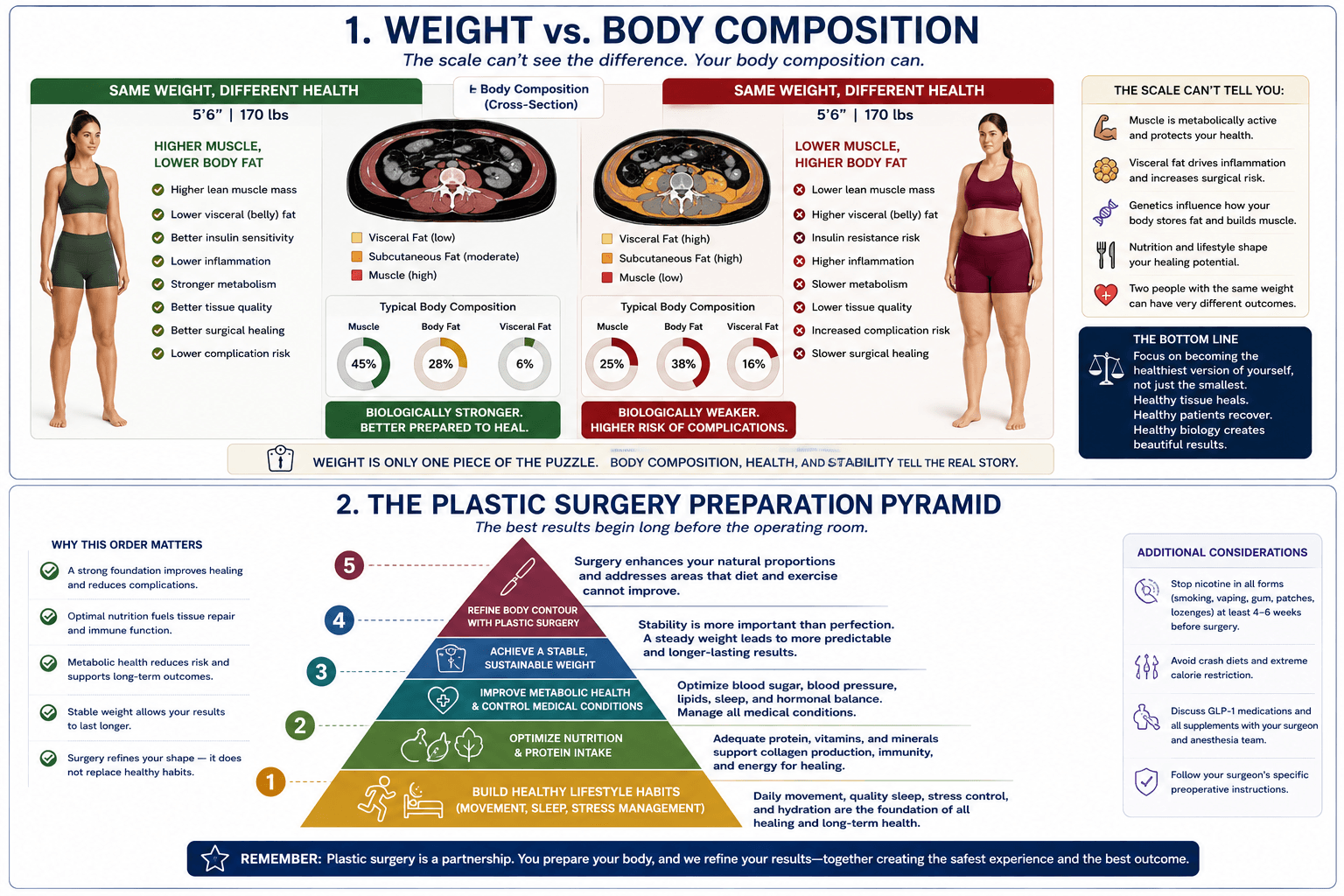
One of the most common questions patients ask before cosmetic surgery is whether they should lose weight first. The answer is often yes, but not always. Successful plastic surgery is determined by much more than the number on a scale. Body composition, muscle mass, nutritional status, metabolic health, skin quality, and weight stability frequently have a greater impact on healing and long-term results than body weight alone. Rather than focusing solely on weight loss, patients should focus on becoming biologically prepared for surgery.
The Number on the Scale Doesn’t Tell the Whole Story
Two women each weigh 170 pounds.
Both are 5’6″.
Both have the same body mass index.
On paper, they appear identical.
Yet one exercises regularly, has excellent muscle mass, eats a protein-rich diet, sleeps well, and has stable metabolic health.
The other is sedentary, has significant visceral fat, poor nutrition, insulin resistance, and little muscle.
Would they be expected to heal the same?
Probably not.
This illustrates one of the biggest misconceptions in cosmetic surgery.
Weight is only one measurement.
Biology is much more complex.
As plastic surgeons, we operate on living tissue, not numbers.
Weight Versus Body Composition
Most patients think their weight is the primary determinant of surgical candidacy.
In reality, body composition often provides much more meaningful information.
Body composition describes what your body is actually made of.
It includes:
- Muscle mass
- Body fat percentage
- Visceral fat
- Subcutaneous fat
- Bone mass
- Water content
These components influence healing, inflammation, strength, mobility, metabolism, and recovery.
Someone with a higher percentage of lean muscle and better metabolic health may recover more efficiently than someone at the same weight with significantly less muscle.
The Mehrzad Clinical Insight
I rarely make recommendations based solely on body weight.
Instead, I look at the whole patient.
How healthy are the tissues?
How stable is the weight?
How is nutrition?
How is metabolic health?
How prepared is the body to heal?
Those answers are often more important than the number on the scale.
Is There an Ideal Weight Before Plastic Surgery?
Patients often hope for a single “magic number.”
Medicine is rarely that simple.
Rather than targeting a specific weight, many plastic surgeons encourage patients to reach a stable, sustainable weight that they believe they can realistically maintain long after surgery.
Why?
Because plastic surgery improves shape, not lifestyle.
If a patient loses a substantial amount of weight after a tummy tuck, body lift, breast surgery, or liposuction, the tissues may change again.
Likewise, significant weight gain after surgery may reduce the longevity of the result.
For most patients, stability is often more valuable than perfection.
Should I Lose Weight Before a Tummy Tuck?
This is one of the most common questions in aesthetic surgery.
The answer depends on several factors:
- Current body composition
- Amount of planned weight loss
- Skin quality
- Muscle separation
- Overall health
- Surgical goals
If a patient plans to lose a significant amount of weight, it is often advantageous to achieve that goal before surgery whenever possible.
This allows the operation to address the tissues after weight has stabilized, rather than attempting to “chase” ongoing body changes.
However, every patient is different.
A personalized evaluation is essential.
What About GLP-1 Medications Like Ozempic, Wegovy, or Mounjaro?
GLP-1 medications have transformed obesity treatment and are helping millions of patients achieve meaningful weight loss.
For many individuals, these medications can improve metabolic health and reduce obesity-related risks.
However, they also introduce important considerations before elective surgery.
Rapid weight loss may affect nutrition, muscle mass, and skin redundancy.
Some patients may experience reduced protein intake because of decreased appetite.
Additionally, these medications may slow gastric emptying, which has implications for anesthesia planning.
Patients should always discuss GLP-1 medications with both their plastic surgeon and anesthesia team before surgery.
Management should be individualized according to the procedure, medical history, and current clinical recommendations.
Muscle Matters More Than Most Patients Realize
Patients often think of muscle only in terms of appearance.
From a surgical perspective, muscle serves many important physiological functions.
Healthy muscle contributes to:
- Better mobility during recovery
- Improved insulin sensitivity
- Greater protein reserves
- Improved metabolic health
- Better physical resilience
Maintaining lean muscle during weight loss is often just as important as reducing excess body fat.
This is one reason why crash dieting immediately before surgery is generally discouraged.
The Goal Is Not to Become Smaller
The goal is to become healthier.
Healthy tissues heal better.
Healthy patients recover more efficiently.
Healthy biology supports better long-term surgical outcomes.
Plastic surgery should never replace healthy habits.
Instead, it should build upon them.
The best operations begin with the healthiest possible foundation.
Key Takeaways
- Body composition often provides more useful information than body weight alone.
- Stable weight is generally preferable to rapid weight loss before elective surgery.
- Significant planned weight loss is often best completed before body contouring procedures.
- GLP-1 medications require individualized discussion with both the surgeon and anesthesia team.
- Muscle preservation, adequate protein intake, and metabolic health play major roles in recovery.
- Plastic surgery is designed to refine body shape, not replace healthy lifestyle habits.
Related Reading
- Why Two Patients Can Have the Same Plastic Surgery…But Completely Different Results
- The Complete Science of Wound Healing
- Why Does Swelling Last So Long After Plastic Surgery?
- Why You Must Stop Smoking and Vaping Before Plastic Surgery
- Protein and Plastic Surgery: Why Nutrition Determines Healing (Coming Soon)
- GLP-1 Medications and Plastic Surgery: What Every Patient Needs to Know (Coming Soon)
Serving patients from Los Alamitos, Long Beach, Seal Beach, Orange County, Cypress, Cerritos, Lakewood, Huntington Beach, Newport Beach, and the greater Los Angeles area.