Journal
The Five Pillars of Biological Capital
An Educational Framework for Understanding Why Healing Differs Between Patients
 Dr. Raman Mehrzad, MDPlastic surgeon
Published July 13, 2026Updated August 18, 20265 min read
Medically reviewed by Dr. Raman Mehrzad, MD. Last reviewed August 18, 2026.
Now: An Educational Framework for Understanding Why Healing Differs Between Patients
An Educational Framework for Understanding Why Healing Differs Between Patients
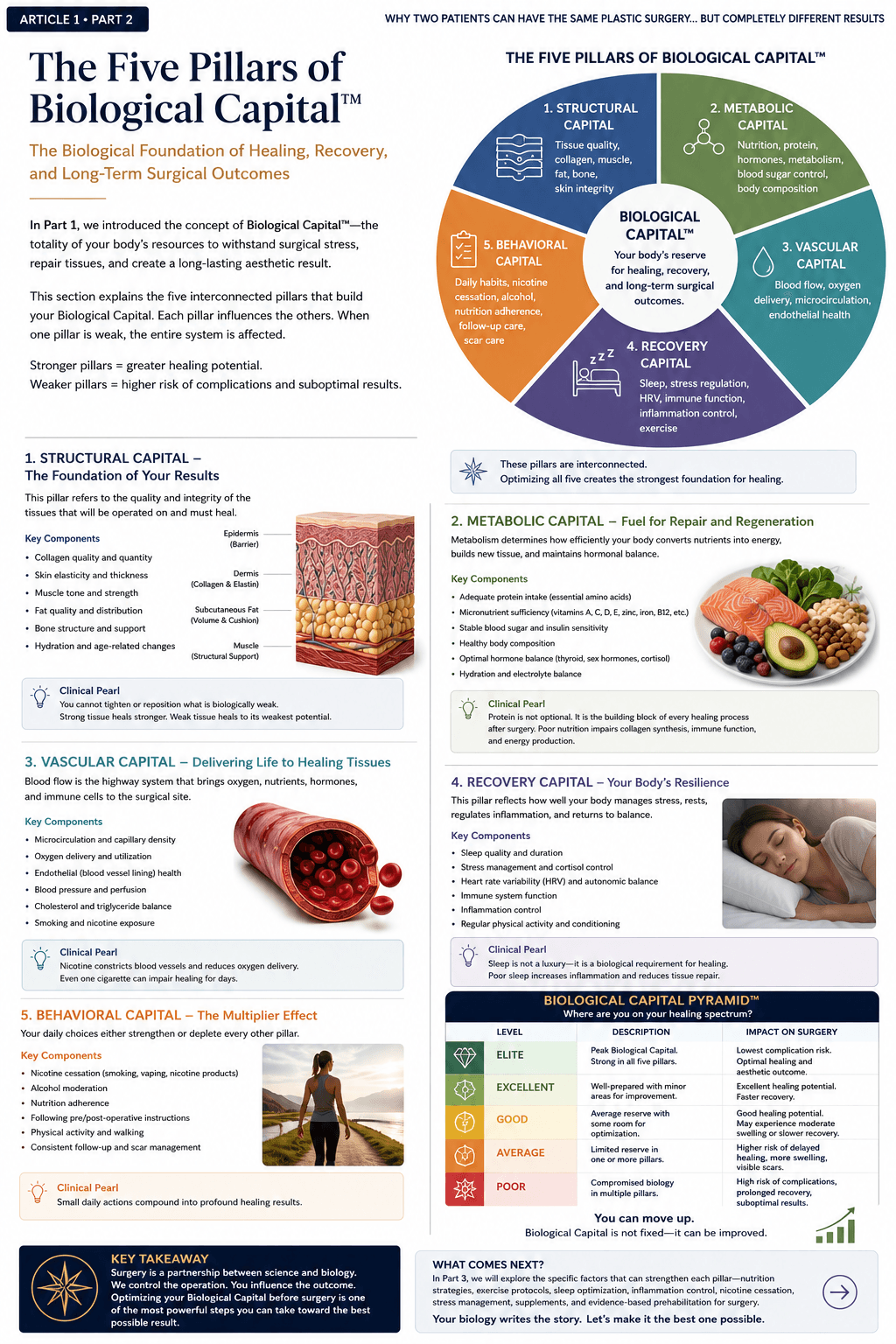
The concept of Biological Capital provides a simple way to understand a complex reality: no two patients enter surgery with the same biological resources available for healing. Although every individual possesses remarkable regenerative capabilities, the quality, efficiency, and predictability of those processes vary considerably.
Rather than viewing recovery as something determined solely by the operation itself, it is more accurate to view it as the interaction between surgical technique and the patient’s biological state at the time of surgery.
For educational purposes, Biological Capital can be divided into five interconnected pillars:
- Structural Capital
- Metabolic Capital
- Vascular Capital
- Recovery Capital
- Behavioral Capital
These pillars constantly influence one another. Weakness in one area often affects the performance of the others.
Pillar One
Structural Capital
The Foundation Upon Which Plastic Surgery Is Performed
Every plastic surgery procedure is ultimately performed on living tissue.
Whether performing a facelift, breast augmentation, rhinoplasty, abdominoplasty, body contouring procedure, or reconstructive operation, the surgeon depends upon the quality of the patient’s tissues.
Structural Capital refers to the physical integrity of those tissues.
It includes:
• Skin thickness
• Skin elasticity
• Collagen quality
• Elastin integrity
• Fat quality
• Muscle condition
• Fascial strength
• Bone support
• Ligament stability
• Hydration of the skin
These characteristics determine how tissues respond to surgical manipulation and how they remodel afterward.
A patient with healthier skin, better collagen organization, and preserved elasticity often demonstrates improved wound strength, more favorable scar maturation, and more predictable long-term contour.
Conversely, chronically sun-damaged skin, severe nicotine exposure, significant collagen degradation, or poor tissue quality may reduce the body’s ability to tolerate surgical stress.
Importantly, Structural Capital is influenced by both genetics and lifestyle.
Although chronological aging cannot be reversed, biological aging of tissues may be modified through healthy lifestyle habits, nutritional optimization, ultraviolet protection, smoking cessation, and appropriate medical management.
Clinical Pearl
Plastic surgeons do not simply reshape anatomy—they work with living tissues whose quality directly influences the final result.
Pillar Two
Metabolic Capital
Providing the Energy and Building Blocks for Healing
Healing is one of the most metabolically demanding processes the human body performs.
Every new collagen fiber, every new blood vessel, every immune cell, and every regenerating tissue requires energy and raw materials.
Metabolic Capital represents the body’s ability to supply those resources.
It includes:
• Protein availability
• Micronutrient status
• Iron stores
• Zinc
• Vitamin C
• Vitamin D
• Vitamin A
• B-complex vitamins
• Blood glucose regulation
• Insulin sensitivity
• Hormonal balance
• Overall nutritional status
Patients often focus almost exclusively on calories before surgery.
From a physiological perspective, nutrient quality is far more important than calorie restriction alone.
Protein deserves particular attention.
Collagen—the primary structural protein responsible for wound strength—cannot be synthesized without an adequate supply of amino acids.
Likewise, immune cells require protein for proliferation and function, while skeletal muscle serves as an important reservoir during periods of physiological stress.
Crash dieting immediately before elective surgery may unintentionally reduce these reserves and impair recovery.
The goal before surgery should not simply be weight loss.
The goal should be metabolic readiness.
Clinical Pearl
The body cannot build new tissue from nutrients that are unavailable.
Healing requires biological building materials.
Pillar Three
Vascular Capital
Delivering Oxygen to Every Healing Cell
No biological process can occur without oxygen.
Every healing wound depends upon an intricate vascular network that continuously delivers oxygen, nutrients, immune cells, hormones, and growth factors.
Vascular Capital refers to the efficiency of this delivery system.
Key determinants include:
• Cardiac function
• Blood pressure regulation
• Microvascular health
• Endothelial function
• Oxygen-carrying capacity
• Hemoglobin concentration
• Hydration
• Smoking status
• Nicotine exposure
• Diabetes
Even the most technically perfect operation cannot overcome profoundly compromised blood flow.
Reduced circulation delays wound healing, impairs collagen synthesis, increases infection risk, and may contribute to tissue necrosis in severe cases.
Nicotine deserves special emphasis.
Nicotine causes vasoconstriction by narrowing blood vessels, thereby reducing tissue perfusion. Carbon monoxide from cigarette smoke further decreases oxygen delivery by binding to hemoglobin with greater affinity than oxygen.
For this reason, virtually every plastic surgeon strongly recommends complete cessation of smoking and nicotine-containing products before elective surgery.
Clinical Pearl
The quality of healing is often limited not by surgical skill but by the tissue’s ability to receive oxygen.
Pillar Four
Recovery Capital
The Body’s Ability to Return to Physiological Balance
Recovery does not begin when swelling disappears.
Recovery begins the moment surgery ends.
Recovery Capital reflects the body’s capacity to regulate inflammation, restore homeostasis, and rebuild tissue after physiological stress.
Major contributors include:
• Sleep quality
• Sleep duration
• Psychological stress
• Chronic inflammation
• Physical conditioning
• Immune competence
• Heart rate variability
• Autonomic nervous system balance
Sleep deserves particular attention.
During restorative sleep, the body regulates numerous hormones involved in tissue repair, immune activity, protein synthesis, and metabolic recovery.
Patients frequently underestimate the cumulative impact of poor sleep leading up to surgery.
Likewise, chronic psychological stress influences cortisol secretion, inflammatory pathways, and immune regulation.
Although surgery cannot eliminate stress, optimizing recovery habits before surgery may improve resilience afterward.
Clinical Pearl
Sleep is not passive recovery.
Sleep is active biological reconstruction.
Pillar Five
Behavioral Capital
The Decisions That Influence Every Other Pillar
The final pillar differs from the previous four.
Behavioral Capital is not something patients are born with.
It is something they choose every day.
Behavioral Capital includes:
• Smoking cessation
• Medication adherence
• Following postoperative instructions
• Daily walking
• Compression garment compliance
• Scar care
• Nutritional consistency
• Hydration
• Physical activity
• Follow-up appointments
Small behaviors accumulate over time.
One healthy decision rarely transforms recovery.
Hundreds of healthy decisions often do.
Conversely, repeated unhealthy behaviors gradually diminish the body’s ability to heal efficiently.
Behavioral Capital therefore acts as a multiplier.
Strong behaviors enhance every other pillar.
Poor behaviors weaken them.
Clinical Pearl
Your surgeon performs the operation.
Your daily decisions influence how that operation heals.
Key Takeaways
- Plastic surgery outcomes are influenced by both surgical technique and patient biology.
- Biological Capital is an educational framework for understanding the physiological factors that contribute to healing.
- The five pillars—Structural, Metabolic, Vascular, Recovery, and Behavioral Capital—are interconnected.
- Weakness in one pillar may affect the performance of the others.
- Unlike genetics, many components of Biological Capital can be improved before elective surgery.
Serving patients from Los Alamitos, Long Beach, Seal Beach, Orange County, Cypress, Cerritos, Lakewood, Huntington Beach, Newport Beach, and the greater Los Angeles area.