Journal
The Complete Science of Wound Healing
How the Human Body Repairs Itself After Surgery, Injury, and Trauma
 Dr. Raman Mehrzad, MDPlastic surgeon
Published July 13, 2026Updated August 18, 20265 min read
Medically reviewed by Dr. Raman Mehrzad, MD. Last reviewed August 18, 2026.
Now: How the Human Body Repairs Itself After Surgery, Injury, and Trauma
How the Human Body Repairs Itself After Surgery, Injury, and Trauma
By Dr. Raman Mehrzad, MD, MBA, MHL
Plastic & Reconstructive Surgeon | Ocean Plastic Surgery Center
In One Minute
Every surgical procedure—from a tiny skin biopsy to a complex body contouring operation—depends on the same remarkable biological process: wound healing. Although patients often think healing ends when stitches are removed, the truth is that healing begins within seconds of an incision and continues for months, sometimes more than a year. During that time, billions of cells coordinate an extraordinarily complex sequence of events involving blood clotting, inflammation, new blood vessel formation, collagen production, tissue remodeling, and scar maturation. Understanding these processes helps explain why some patients heal quickly while others experience prolonged swelling, thicker scars, delayed recovery, or wound complications. Plastic surgery offers one of the clearest windows into this biology because the quality of healing is not only a medical outcome—it is also an aesthetic one.
Why Every Plastic Surgery Patient Should Understand Wound Healing
Ask most people what determines the success of plastic surgery and they will usually answer with one word:
"The surgeon."
That answer is only partially correct.
An experienced plastic surgeon brings years of training, technical precision, judgment, and artistry to the operating room. Those skills are essential. But even the most technically perfect operation ultimately depends on something no surgeon can completely control: how the patient’s body heals.
The surgeon performs the operation.
The body performs the recovery.
Every incision, every suture, every liposuction tunnel, every facelift flap, and every breast reduction relies on the body’s ability to repair itself. Without wound healing, surgery would simply be injury. Healing is what transforms an operation into a successful outcome.
This is why wound healing deserves far more attention than it typically receives. It is not simply a postoperative process—it is the biological foundation upon which every surgical result is built.
Healing Begins Before the First Incision
One of the most common misconceptions is that healing starts after surgery.
In reality, healing begins before the operation ever takes place.
The condition of your skin, your nutritional status, your cardiovascular health, your blood sugar control, your sleep quality, your level of physical activity, your protein intake, your medications, your smoking history, and even your chronic stress levels all influence the biological environment that will respond once surgery begins.
Think of the body as a construction site preparing for a major renovation.
If the building materials are already stocked, the workers are healthy, the blueprints are organized, and the supply chain is functioning efficiently, construction proceeds smoothly.
If the materials are scarce, the workers are exhausted, and deliveries are delayed, even the best architect cannot keep the project on schedule.
Healing follows the same principle.
Surgery creates the opportunity for repair.
Biology determines how efficiently that repair occurs.
Wound Healing Is One of the Most Sophisticated Biological Processes in the Human Body
At first glance, a healing incision appears deceptively simple.
The skin closes.
The redness gradually fades.
The scar softens.
Eventually it becomes difficult to see.
Beneath the surface, however, an extraordinary biological orchestra is performing.
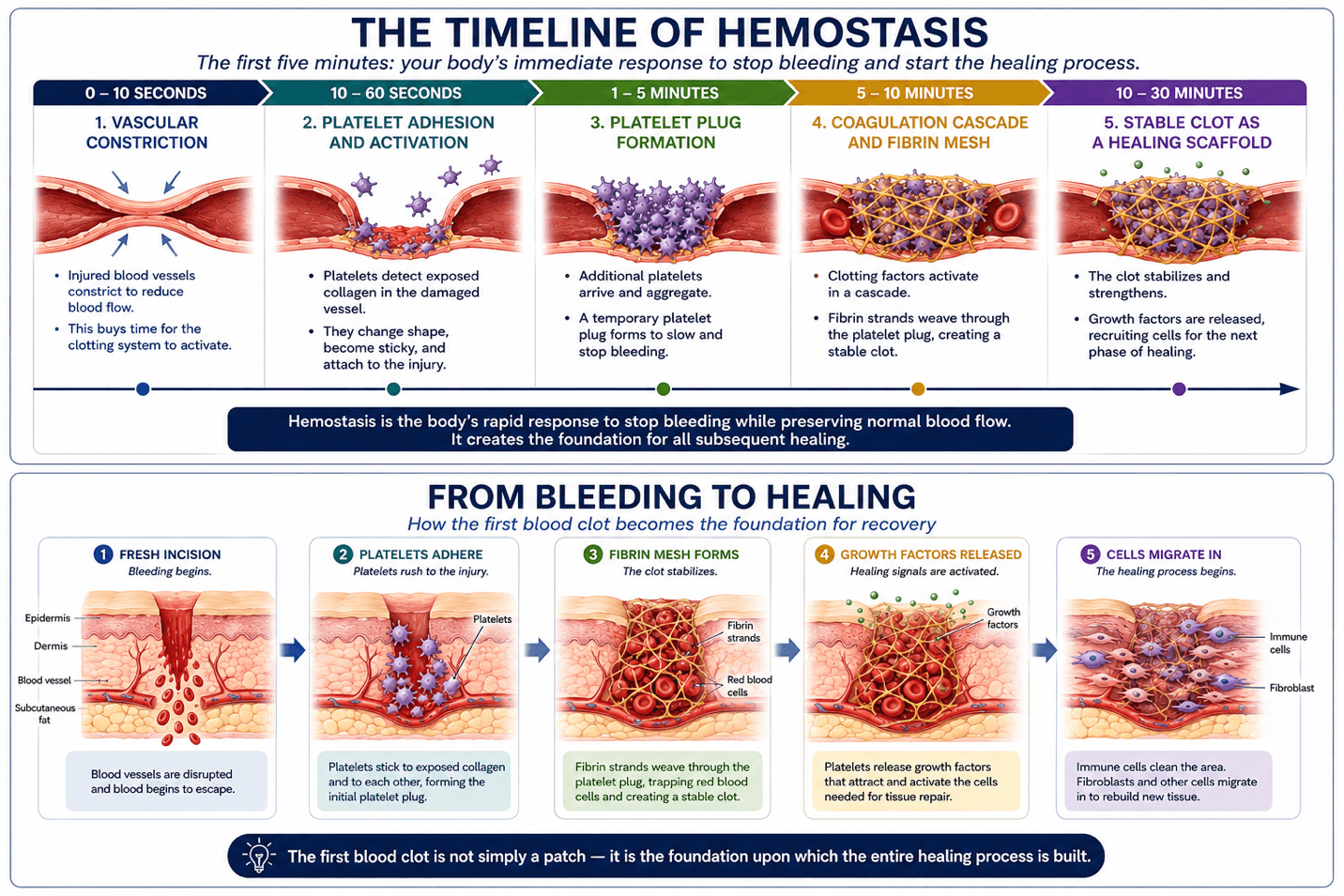
Within seconds, specialized proteins circulating in the bloodstream begin forming a clot to stop bleeding. Platelets release powerful signaling molecules that serve as chemical messengers, calling immune cells to the injured area.
Within minutes, blood vessels change their behavior to regulate blood flow and allow inflammatory cells to enter the surrounding tissues.
Within hours, neutrophils—the body’s first responders—begin removing bacteria, damaged cells, and microscopic debris created during surgery.
Soon afterward, macrophages arrive. Once thought to be little more than cellular "garbage collectors," these remarkable cells are now recognized as conductors of healing. They remove damaged tissue, coordinate inflammation, release growth factors, and signal the next generation of repair cells to begin rebuilding.
Fibroblasts migrate into the wound and begin producing collagen, the protein responsible for providing strength to healing tissues.
Endothelial cells construct entirely new microscopic blood vessels through a process known as angiogenesis, restoring oxygen and nutrients to recovering tissue.
Keratinocytes migrate across the wound surface, rebuilding the protective outer layer of skin.
Myofibroblasts generate mechanical forces that gently contract the wound, reducing its size as healing progresses.
Even after the incision appears healed externally, collagen fibers continue reorganizing, strengthening, and aligning themselves according to the natural mechanical stresses placed upon the tissue.
This remodeling phase continues for many months and explains why scars often continue improving long after patients believe healing is complete.
Healing is not a single event.
It is a carefully coordinated biological conversation involving millions of cells and thousands of molecular signals, each performing a specific role at precisely the right moment.
The Four Phases of Wound Healing
Although healing occurs as one continuous process, physicians generally divide it into four overlapping phases. These phases do not function as isolated steps but rather blend seamlessly into one another, with each stage preparing the body for the next.
The four phases are:
Phase 1: Hemostasis – stopping bleeding and stabilizing the wound.
Phase 2: Inflammation – cleaning the wound and coordinating the body’s initial response.
Phase 3: Proliferation – rebuilding tissue through collagen production, angiogenesis, and skin regeneration.
Phase 4: Remodeling – strengthening and refining the repaired tissue over the following months.
Understanding these phases explains nearly every aspect of postoperative recovery, including swelling, bruising, scar formation, firmness, numbness, itching, and the gradual improvement that continues long after surgery.
In the following sections, we will examine each phase individually, beginning with the remarkable events that occur during the very first seconds after an incision is made.
What Your Cells Are Doing Right Now
If you are reading this while recovering from surgery, your body is working continuously—even while you sleep.
At this very moment, millions of cells are communicating with one another. Some are removing damaged tissue. Others are producing collagen. New microscopic blood vessels may be forming beneath your incision. Immune cells are coordinating inflammation. Fibroblasts are strengthening your wound. Nerve fibers are slowly regenerating. Scar tissue is reorganizing itself.
Healing is not something that happens once a day during a dressing change.
It is happening every second.
And that is one of the most remarkable abilities of the human body.
Serving patients from Los Alamitos, Long Beach, Seal Beach, Orange County, Cypress, Cerritos, Lakewood, Huntington Beach, Newport Beach, and the greater Los Angeles area.