Journal
Building Biological Capital Before Surgery
The Science of Preparing Your Body to Heal
 Dr. Raman Mehrzad, MDPlastic surgeon
Published July 13, 2026Updated August 18, 20266 min read
Medically reviewed by Dr. Raman Mehrzad, MD. Last reviewed August 18, 2026.
Now: The Science of Preparing Your Body to Heal
The Science of Preparing Your Body to Heal
If surgery is the event, preparation is the foundation.
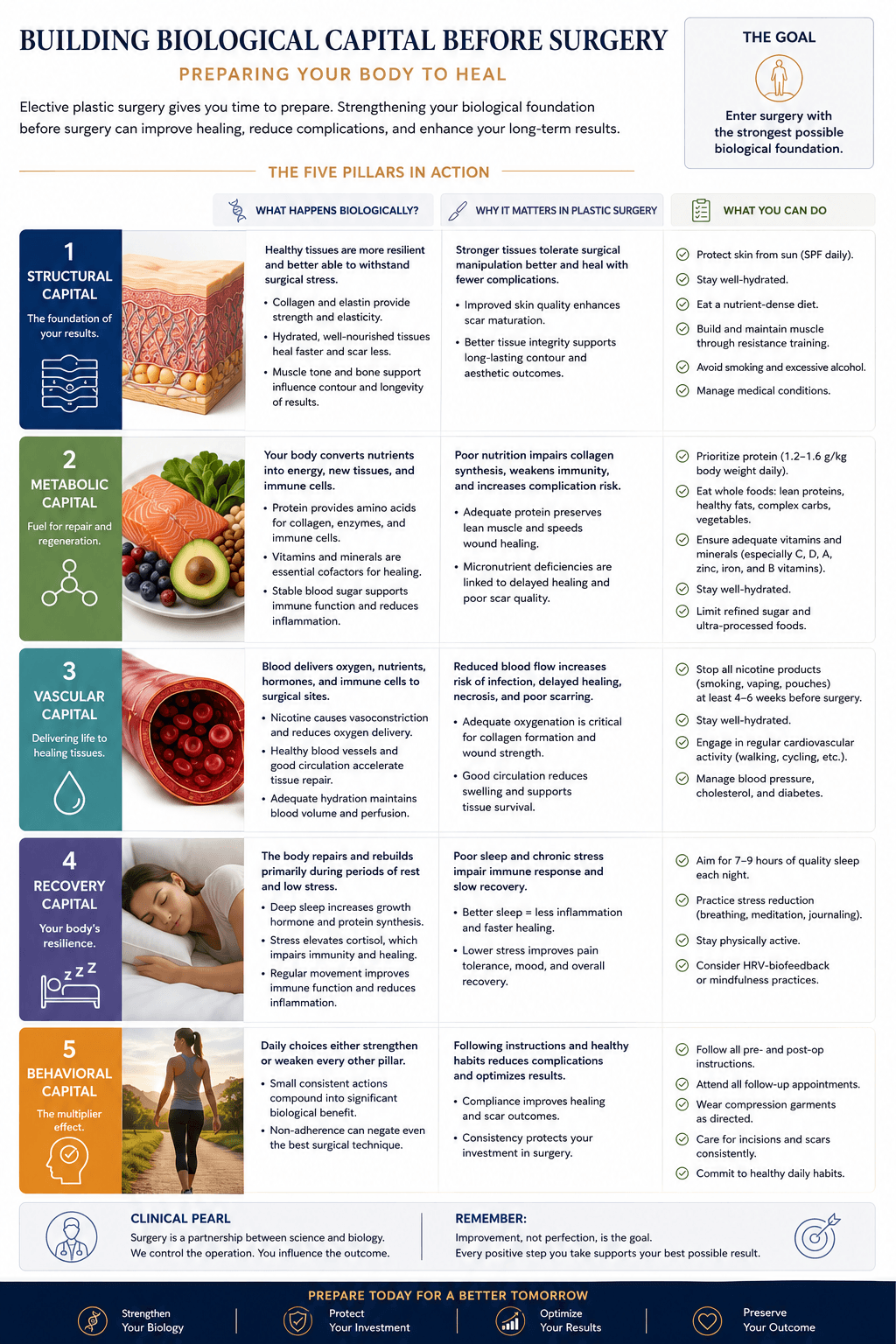
One of the greatest advantages of elective plastic surgery is that, unlike emergency surgery, patients usually have time to prepare. This period—often several weeks before an operation—provides an opportunity to improve the biological environment in which healing will occur.
Many patients spend this time purchasing compression garments, arranging transportation, or preparing their home for recovery. Those tasks are important, but they are logistical preparations.
Biological preparation is different.
It focuses on strengthening the body’s ability to respond to surgery through evidence-based improvements in nutrition, sleep, physical conditioning, metabolic health, circulation, and lifestyle habits.
The goal is not perfection.
The goal is to help the body begin surgery from the strongest possible starting point.
Protein: The Raw Material of Healing
If there is one nutrient that deserves special attention before surgery, it is protein.
Protein is not simply another component of a healthy diet. It provides the amino acids required to build new tissue during recovery.
After surgery, the body’s demand for protein increases substantially. Amino acids are used to synthesize collagen, produce enzymes, support immune cell function, rebuild muscle tissue, and repair surgical wounds.
Without adequate protein, the body cannot efficiently perform these tasks.
Patients often assume that because they eat "fairly healthy," they are consuming enough protein. In reality, many adults—particularly older individuals and those intentionally restricting calories before cosmetic surgery—consume less protein than is optimal during periods of physiological stress.
This is one reason why aggressive crash dieting immediately before surgery may be counterproductive.
Weight loss achieved at the expense of lean muscle mass may reduce the body’s reserve of amino acids precisely when those reserves are needed most.
The objective before surgery is not simply to lose weight.
It is to preserve and support the tissues that will participate in healing.
Clinical Pearl
Protein is not merely fuel.
It is the raw material from which your body rebuilds itself.
Inflammation: A Necessary Response That Must Remain Balanced
Patients often think of inflammation as something inherently harmful.
In reality, inflammation is essential.
Without inflammation, wounds would not heal.
Immediately after surgery, inflammatory cells migrate to the surgical site to remove damaged tissue, prevent infection, and initiate repair.
This early inflammatory response is beneficial and necessary.
Problems arise when inflammation is excessive, prolonged, or poorly regulated.
Chronic inflammatory states—associated with obesity, poorly controlled diabetes, smoking, inadequate sleep, chronic psychological stress, and certain medical conditions—may alter normal healing and contribute to prolonged swelling, delayed recovery, and impaired tissue remodeling.
The objective before surgery is therefore not to eliminate inflammation.
It is to create an environment in which the body can mount an appropriate inflammatory response and then transition efficiently into tissue repair and remodeling.
This distinction is frequently misunderstood.
Inflammation itself is not the enemy.
Uncontrolled inflammation is.
Clinical Pearl
Successful healing depends not on avoiding inflammation, but on resolving it appropriately.
Sleep: The Most Underrated Surgical Preparation
Many patients focus intensely on supplements while overlooking one of the most powerful biological processes available to them every night.
Sleep.
During restorative sleep, the body coordinates countless physiological functions involved in recovery.
Growth hormone secretion increases.
Protein synthesis is enhanced.
Immune regulation is optimized.
Inflammatory signaling is balanced.
Memory is consolidated.
Energy stores are replenished.
These processes become particularly important following surgery, when tissue repair is occurring at an accelerated pace.
Even several nights of inadequate sleep may influence immune function, metabolic regulation, and inflammatory pathways.
Although no patient needs perfect sleep before surgery, developing consistent sleep habits during the weeks leading up to an operation represents one of the simplest and most evidence-supported ways to improve recovery capacity.
Clinical Pearl
Sleep is not time lost.
It is time invested in biological repair.
Exercise: Training for Recovery
Patients often ask whether they should exercise before surgery.
The answer, for most individuals, is yes—within the limits of their health and the recommendations of their physician.
Exercise does far more than strengthen muscles.
Regular physical activity improves cardiovascular function, enhances insulin sensitivity, supports endothelial health, increases mitochondrial efficiency, preserves lean muscle mass, and contributes to psychological well-being.
Collectively, these adaptations improve the body’s resilience.
Importantly, the objective before surgery is not to achieve peak athletic performance.
Nor is it an opportunity for intense last-minute training.
Rather, it is an opportunity to improve overall physiological reserve.
Walking, resistance training, flexibility exercises, and cardiovascular conditioning all contribute to the body’s ability to tolerate surgical stress and recover afterward.
Patients who are already physically active should generally continue appropriate exercise until instructed otherwise by their surgeon.
Patients who are sedentary may benefit from gradually increasing daily movement before surgery rather than waiting until recovery has begun.
Clinical Pearl
The strongest body is not always the body that heals best.
The best-prepared body usually does.
Nicotine: One of the Few Truly Modifiable High-Risk Factors
Few lifestyle factors have been studied as extensively in plastic surgery as nicotine exposure.
Nicotine causes blood vessels to constrict, reducing blood flow to healing tissues.
Smoking also introduces carbon monoxide, which decreases the oxygen-carrying capacity of blood.
Together, these effects impair the delivery of oxygen and nutrients precisely where they are needed most.
For procedures that depend heavily on tissue perfusion—such as facelifts, breast reductions, tummy tucks, body contouring, and reconstructive flap surgery—the consequences may be significant.
Reduced blood flow increases the risk of delayed wound healing, infection, skin loss, fat necrosis, widened scars, and other complications.
Importantly, this concern extends beyond traditional cigarettes.
Many vaping products, nicotine pouches, cigars, and other nicotine-containing products may produce similar physiological effects.
Patients should always discuss nicotine use openly with their surgeon, even if they believe a particular product is "safer."
Clinical Pearl
From the perspective of wound healing, the question is not whether nicotine is smoked or inhaled.
The question is whether it reaches the bloodstream.
Biological Preparation Is Not About Perfection
Many patients worry that they need to become the healthiest version of themselves before surgery.
That is rarely realistic.
The purpose of biological preparation is not perfection.
It is improvement.
Every positive step—whether increasing daily protein intake, quitting nicotine, improving sleep, controlling blood sugar, becoming more physically active, or reducing chronic stress—represents an investment in the body’s ability to heal.
These improvements are cumulative.
Small changes performed consistently over several weeks often provide greater benefit than dramatic changes attempted only a few days before surgery.
Plastic surgery is ultimately a partnership.
The surgeon provides technical expertise.
The patient provides the biological environment in which that expertise must succeed.
The strongest outcomes occur when both sides of that partnership are optimized.
Key Takeaways
- Elective plastic surgery offers a unique opportunity to optimize healing before the operation begins.
- Protein, sleep, exercise, inflammation control, and nicotine cessation all influence the biological processes involved in tissue repair.
- The goal is not to eliminate inflammation but to support a healthy, well-regulated healing response.
- Exercise builds physiological reserve rather than simply improving appearance.
- Even modest improvements before surgery can strengthen the body’s ability to recover.
Serving patients from Los Alamitos, Long Beach, Seal Beach, Orange County, Cypress, Cerritos, Lakewood, Huntington Beach, Newport Beach, and the greater Los Angeles area.